Showing posts with label McMurdo. Show all posts

Saturday, December 8, 2012

Where's Antarctica?!

It's Sunday morning, here at McMurdo--a day for sleeping in a little, checking and re-checking gear, and maybe going for a stroll around Ob' Hill before station wakes up for a mid-day brunch. 

Imagine my surprise, when I awoke this morning and headed towards the Crary Laboratory: McMurdo Sound is socked in with thick fog.


Dude, where's my continent?

Normally, I should be able to look out my lab window and see the Dry Valleys and the Royal Society Range soaring up from above the Ross Sea. This morning, it's just thick, billowy white out there. Part of the Crary Laboratory building is in the foreground.  

My guess is that the warm weather we've been having here at McMurdo (high temperature today: +4˚C or 39˚F) has led really humid air developing during the day (lots of snow and ice to melt). When temperatures drop at "night" (when the sun is low in the sky--but still above the horizon) to temperatures below freezing, all this moisture condenses out and forms the thick fog banks that can cut McMurdo off from the rest of the Ross Sea region. 

It's lovely, if a little mysterious, on a Sunday morning. But fog like this on a working day means no helo flights and no planes coming or going from Christchurch. I hope it clears up before Wednesday: we're hoping to fly across the sound on 12/12/12, and don't want to land at Camp Brigadoon.

UPDATE: 13:30


That's better. Mount Discovery is back, peeking out above the fog, along with the Kukri Hills (the low hills to the right).

Thursday, December 6, 2012

Sweet home McMurdo -- And Happy Campers

The weather in Christchurch, New Zealand, has been beautiful all week. The problem is, it's been snowing in McMurdo, which means our plane could not safely land. New Zealand is a nice place to be stranded, but after three days of waiting for the weather to clear, the advance team was ready to go.

And here we are! After a loud, bumpy, long flight south in an old-fashioned C130 cargo plane, we arrived last night. 

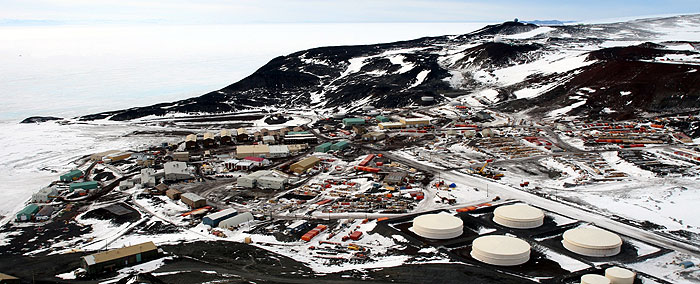
Here's what the scene looks like at McMurdo. (The McMurdo webcam is also a pretty good way to check out the weather on station--we kept a close eye on the camera from New Zealand to see when the weather would clear. 

Right now we need to prepare to get into the field and to make up for those lost days in New Zealand. Our new Antarcticans (Lily and Kelly) are off at Happy Camper school, the nickname we give to Antarctic Survival training. 


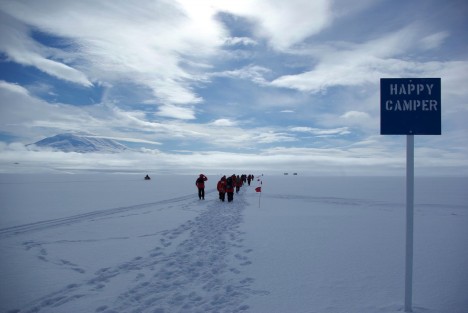
Happy Campers walk down a flag-line trail on the Ross Ice Shelf. Photo courtesy Ludovic Bruker.

Antarctica can be a dangerous place, so snow school teaches new Antarcticans how to prepare themselves for extreme cold weather. The two-day course is taught mostly outside. 


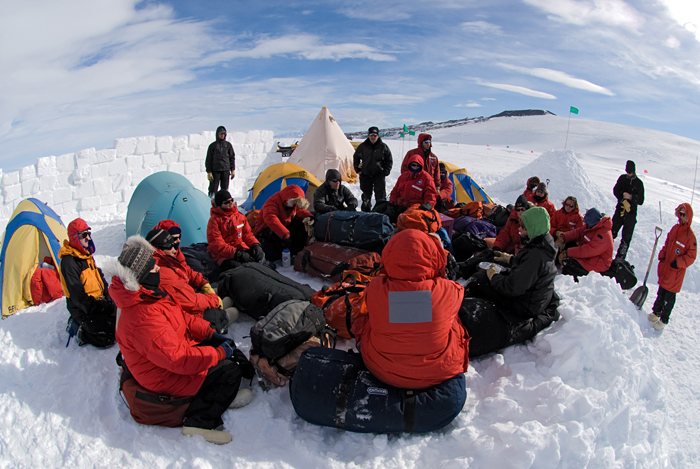
Happy Campers take shelter behind a wall made out of snow blocks (quarry your own!) and listen to a field safety instructor. A yellow, pyramid-shaped Scott Tent is in the background, next to a pyramid-shaped snow cave. Cozy. Image courtesy Chris Linder, WHOI.

Campers learn how to make the most of their extreme cold weather clothes; how to assemble the various tents they might be living in; how to prepare emergency snow shelters; and how to use the radios that are the main way we communicate with McMurdo station when we're in the field. 


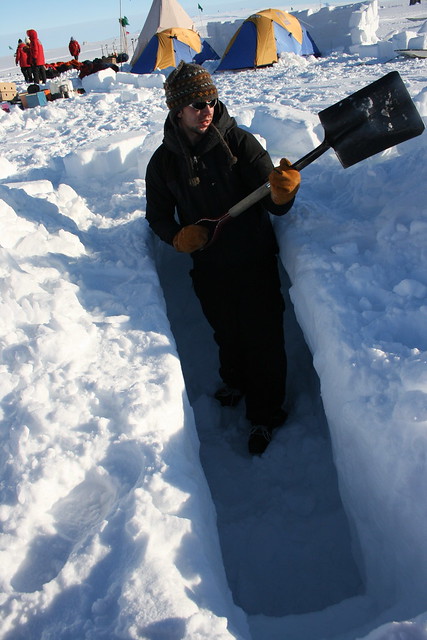
It isn't much, but a snow trench makes for a good spot to sleep out of the wind in the event of emergency. Photo courtesy Eli Duke. 

Campers also learn how to use emergency stoves to cook survival rations (yummy), and how to diagnose and treat cold injuries like frostbite. Most of the time, people who get frostbite don't even notice it, which is why it's important for our team to keep an eye on each other (particularly, each others' noses, which can freeze in a strong wind). 

The most memorable moment for many people is during the whiteout drill. When the snow blows in to McMurdo (like it did the last few days, keeping us from flying in), a whiteout can make it impossible to see more than a few inches in front of your face. The bucket-head drill simulates a whiteout. Campers have to search for a friend who's gone missing in the snow. 


Can you see him? I can't even see my luxurious moustache! Image from Kenneth Sims, UWY

Meanwhile, Jay and I (safely without buckets on our heads) are packing up camp gear and getting logistics ready for our move to the field. More about what you pack for lunch (and breakfast and dinner) in Antarctica in an upcoming post. 


Thursday, January 5, 2012

New season, new links

I'm back in McMurdo, and a 2011-2012 season set of posts is soon going to be on its way. In the interim, for anyone who didn't see it, here's a link to the CBS Sunday Morning coverage of Antarctica, and the LTER's work there: "Destination Antarctica."

For those looking for something new, here's a view of the McMurdo Station live webcam.

Saturday, December 18, 2010

Northbound

It's been a busy week in McMurdo trying to get prepared to leave Antarctica tomorrow. My team and I have been busily cleaning and returning gear to the Berg Field Center and the Crary Lab.

The biggest task this week has been preparing samples to be shipped north. I've got all kinds of samples that all have different processing and transportation requirements. It's kind of like trying to figure out how to load a grocery bag. You want your ice cream to stay frozen, your apples not to get bruised, and your eggs not to crack. Only here, I need my ice cores (from Garwood) to stay frozen, my soils (from Taylor) not to grow mold, and my rocks (from everywhere) not to get chipped. Fortunately, the cargo vessel that will be docking in McMurdo next month has freezers, coolers, and giant storage containers aboard that should get my samples home safe and sound.

Since Antarctica is in the southern hemisphere, and Portland is in the northern hemisphere, the ship has to cross the equator to get my samples home. It's pretty impressive to think that the ship can keep ice cores at -20*C (-4*F), even when it's 90*F outside. Since my soils don't need to be in a freezer the whole way back, they need to be dried so that they don't grow mold in the heat (the same way foods like potato chips or raisins are dried to keep them from getting moldy).

I'd say it has been a great season. We've learned a lot about how the "invisible streams" in Taylor Valley (the water tracks) come out of their winter freeze. In Garwood, we've begun to explore a frozen world that existed almost 10,000 years ago. It's been an adventure at times:

Sampling algal mats at the top of the Garwood Valley "ice cliff." It might not seem  like much of an adventure, but to get there I had to cut toe holds in the ice...
...all the way up to the top of the wall here. It's worth it, though, since we can carbon date the algae in the sediments. The sediments are on top of the ice, so the ice has to be at least as old as the sediments that bury it (geologists call this "the law of superposition). Get an age for the algae, and we've got an age for the ice. 
It's also been a great deal of fun. My colleagues--both the scientists, and the support personnel--have been a pleasure to work with. I'm definitely ready to be heading home, but a little piece of me is already excited about continuing to explore in Garwood valley next year!

Stay tuned to this blog during the "off season" for updates on what we've found in the Dry Valleys, news about publications, and more stereo pictures!

Northbound tomorrow.

Thursday, November 4, 2010

Back in Town

I'm back at McMurdo Station this weekend to process the samples I've been collecting over the past three weeks!


McMurdo Station is the main US base in Antarctica and is home (as of yesterday) to 1143 scientists and support staff (I guess I make it 1144 in total). The base is perched on the rocky shores of Ross Island, about a 45 minute helicopter flight from Lake Hoare in Taylor Valley.

In the above photo, you can see the big fuel tanks (to the right) that keep the lights on and the buildings warm. In the middle of the picture is the cargo yard, where several years of supplies are kept (in case weather turns bad, planes can't fly, and the resupply ship can't break through the ice). Over on the left side of the image is a gray building that's in three pieces connected by ramps. That's the Crary laboratory, which is the scientific heart of the station. It's where I'm writing from right now!

The bright white expanse to the far left is the frozen surface of the Ross Sea. All in all, it's a very tidy station, but after a few weeks out hiking and sampling, it seems like the big city!

In my next post, we'll take a closer look at what I'm doing in the lab, and just what it means to be washing dirt.